Emotional marketing is one of the most effective ways to connect with your customers and create an emotional connection.
When done correctly, it can result in increased loyalty, word-of-mouth marketing, and higher profits.
In this article, we will discuss some of the best emotional marketing statistics for 2026.
Editor’s Pick (Top Emotional Marketing Stats of 2026)
- Emotional marketing market are expected to touch 12.1 billion dollars by 2030
- Purely emotional content type Ads copy performs twice as well (31% vs. 16%) compare to those with only rational content
- The rate of customers who recommend a brand based on emotional connection is 71%
- 69% of Americans say emotions influence what they buy.
- 23% of sales spikes are generated by ads with above-average emotional responses.
- 70% of viewers who are very likely to buy a product were emotionally triggered by an advertisement
- Click-through rates for headlines with negative superlatives (“worst” or “never”) are 30% higher than those with positive superlatives (“best” or “always”)
- An emotional connection between a customer and the organization is 52% more valuable than a highly satisfied customer
- There is a 38% chance that anger-inducing content will go viral
- A mere 15% of consumers say that brands have a good ability to form emotional bonds with them
- In terms of emotional engagement with brands, Italians are at the forefront (65%)
- 82% of consumers are loyal to their favorite brands when considering their purchase decisions (compared to only 38% of consumers with low emotional engagement)
- 95% of purchases are influenced by subconscious factors
We will explore how emotional marketing affects different aspects of business, such as customer loyalty and purchasing decisions.
By understanding these Emotional Marketing Stats, you can create a more effective emotional marketing strategy for your business!




Topic Covered:
-
What is Emotional Marketing?
-
Benefits of Emotional Marketing
-
Emotional Marketing Facts
-
Emotional Marketing Trends
NOTE: If you are looking for an all-in-one sales and marketing platform then I’ll recommend you to use GoHighLevel. You can use our exclusive link to get GoHighLevel 30 Day Free Trial.
67 Eye-opening Emotional Marketing Statistics 2026

1. Purely emotional content type Ads copy performs twice as well (31% vs. 16%) compare to those with only rational content
The IPA dataBANK is full of 1400 case studies on successful advertising campaigns.
According to it, ads with purely emotional content perform twice as well as those with only rational content (31% vs. 16%).
This proves that people respond more strongly to ads that touch on their emotions, whether it’s happiness, sadness, anger, or fear.
And while we might not always be aware of it, emotions play a big role in our decision-making process.
So the next time you’re planning an ad campaign, make sure to tap into your audience’s emotions to create a truly effective and memorable ad.
2. The rate of customers who recommend a brand based on emotional connection is 71%
It’s no secret that customers who feel emotionally connected to a brand are more likely to become lifelong fans.
But according to a recent study by Motista, the benefits of an emotional relationship go even further than customer loyalty.
The study found that customers with an emotional connection to a brand have a 306% higher lifetime value.
They also recommend the company at a rate of 71%, compared to the 45% average recommendation rate for customers without an emotional connection.
In other words, an emotional relationship with a brand is not only good for customer retention – but it’s also good for business.
3. 23% of sales spikes are generated by ads with above-average emotional responses.
If you’re in the business of advertising, it’s important to know what drives conversions.
Does a rational approach work best, or do customers respond more to ads that provoke an emotional response?
Nielsen did research on it.
The research looked at 100 ad copies from 25 different brands and found that those with an above-average emotional response generated 23% more sales volume than ads that didn’t elicit an emotional reaction.
This suggests that ads that can evoke an emotional response from viewers are more likely to lead to conversions.
So if you’re looking to boost your bottom line, it might be time to start thinking about how you can get your customers to feel something when they see your ad.
4. Click-through rates for headlines with negative superlatives (“worst” or “never”) are 30% higher than those with positive superlatives (“best” or “always”)
A recent study by Outbrain revealed some interesting insights into what makes a headline successful.
After analyzing 65,000 headlines, they found that headings with negative superlatives (“worst” or “never”) had 30% higher click-through rates than those with positive superlatives (“best” or “always”).
This may seem counterintuitive, but it appears that readers are more likely to engage with headlines that promise to reveal something negative.
Whatever the reason, this study provides valuable insights into how to craft a headline that will grab attention.
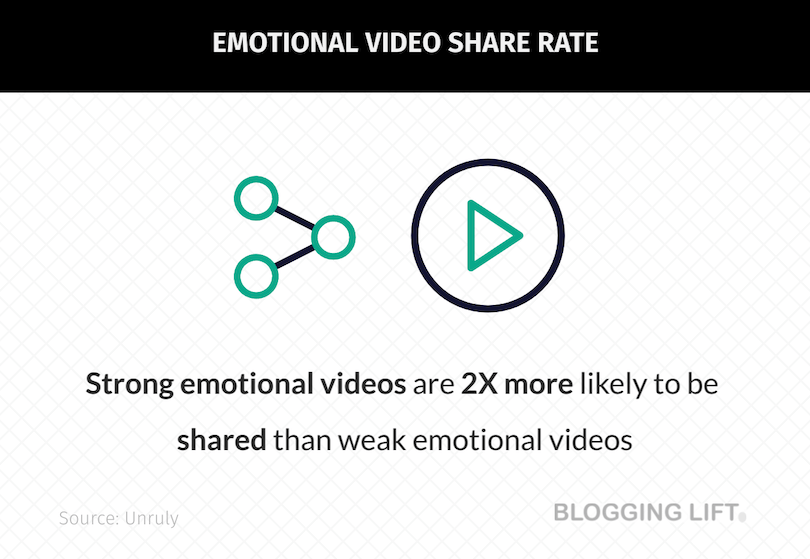
According to a recent study by Unruly, strong emotional videos are twice as likely to be shared as weak emotional videos.
This suggests that people are more likely to share content that makes them feel strongly, whether it’s positive or negative.
So if you’re looking to create shareable video content, it’s important to focus on creating something that will elicit a strong emotional reaction from viewers.
6. An emotional connection between a customer and the organization is 52% more valuable than a highly satisfied customer
As any business knows, customer satisfaction is essential for success.
However, a new study from Harvard Business Review has found that customer loyalty is even more important.
The study found that customers who have an emotional connection to the organization are 52% more valuable than those who are simply highly satisfied.
This is because emotionally connected customers are more likely to become lifelong advocates for the organization.
They are also more likely to make impulse purchases, recommend the organization to others, and forgive mistakes.
As a result, businesses should focus on creating emotional connections with their customers to build long-term loyalty.
Moz found in a case study that there is a 38% chance that content that induces anger will go viral.
Don’t get it wrong. Introducing anger doesn’t mean that you should insult your reader. Instead, you should focus on writing about controversial topics and showing anger about this topic.
So, When writing about a controversial issue, it is important to direct your anger toward the topic, not your readers.
This will help keep the discussion civil and respectful. Everyone will have a different opinion, so be sure to present your argument fairly and without insult.
8. A mere 15% of consumers say that brands have a good ability to form emotional bonds with them
In today’s competitive marketplace, it is more important than ever for brands to form emotional bonds with consumers.
However, according to a recent study, only 15% of consumers say that brands have a good ability to do so.
This means that the vast majority of brands are failing to connect with consumers on an emotional level.
What are the reasons for this?
One possibility is that many brands are simply too focused on selling products and fail to take the time to establish a personal connection with consumers.
Another possibility is that many brands lack the necessary creativity and imagination to form emotional bonds with consumers.
Whatever the reason, it is clear that more work needs to be done if brands want to connect with consumers on an emotional level.
Otherwise, they risk losing their connection with them entirely.
9. In terms of emotional engagement with brands, Italians are at the forefront (65%)
A recent study has revealed some interesting insights into the way customers in different regions emotionally connect with brands.
The study found that Italians are the most emotionally engaged with brands, with 65% of respondents saying that they have a strong emotional connection with at least one brand.
This is followed by Brazil, where 57% of respondents said they have an emotional connection with brands.
The UK came in third, with 44% of respondents reporting a strong emotional connection with brands.
Sweden was at the bottom of the list, with just 33% of respondents saying they have an emotionally engaged relationship with brands.
These findings suggest that there are some significant differences in the way customers in different regions emotionally connect with brands.
10. 82% of consumers are loyal to their favorite brands when considering their purchase decisions (compared to only 38% of consumers with low emotional engagement)
As any business owner knows, customer loyalty is essential to the success of any company.
Not only do loyal customers provide a steady stream of revenue, but they also help to spread word-of-mouth about your business.
However, fostering customer loyalty can be a challenge. A new study conducted by Brand Keys sought to understand what makes customers loyal to a brand.
The study found that emotional engagement is key: 82% of consumers with high emotional engagement would always buy from the brand they are loyal to, compared to only 38% of those with low emotional engagement.
The study also found that customers who feel emotionally engaged with a brand are more likely to recommend it to others and to forgive it for mistakes.
These findings suggest that businesses should prioritize creating an emotional connection with their customers if they want to foster loyalty and long-term success.
11. 95% of purchases are influenced by subconscious factors
When it comes to making a purchase, 95% of the decision is made subconsciously.
That means that emotions play a huge role in whether or not someone buys a product.
In fact, emotions are the most significant subconscious factor influencing buying decisions.
If you can tap into the emotional needs of your target customer, you’ll be much more likely to make a sale.
So what does this mean for businesses? It means that if you want to increase sales, you need to focus on creating an emotional connection with your customers.
Make them feel good about your product and themselves, and you’re much more likely to make a sale.
There are countless ways to do this, so get creative and think outside the box. The more you can tap into your customer’s emotions, the more successful you’ll be.
12. 70% of viewers who are very likely to buy a product were emotionally triggered by an advertisement
A recent study has found that 70% of viewers who are very likely to buy a product were emotionally triggered by an advertisement.
This is twice the 30% who are likely to purchase the product due to a merely reasonable emotional response they experienced.
The study shows that advertisers who create ads that evoke an emotional response are more likely to succeed in selling their products.
This is because emotions play a key role in influencing our behavior.
So if you want to increase your chances of success, try creating an ad that will trigger an emotional response in your target customer.
13. Emotional marketing campaigns have a 31% success rate
Emotions are a powerful tool in marketing.
Campaigns that focus on feelings like joy, nostalgia, or even fear resonate more with people than those based only on logic.
They connect with the audience on a personal level, making the message more memorable and effective.
According to a study by Neurosciencemarketing, emotional marketing campaigns have a 31% success rate compared to purely rational ones.
This shows that emotions aren’t just useful—they’re essential for creating impactful advertising.
14. Over 51% of financial services customers are emotionally engaged, leading the sector
Building trust and emotional bonds is critical in industries where decisions feel personal, like finance.
Customers want to feel safe and confident when choosing where to save or invest their money.
Financial services have mastered this better than other sectors, showing the value of emotional connection.
A report by Capgemini states that over 51% of customers in financial services feel emotionally engaged with their providers.
This highlights the opportunity for businesses to focus on empathy and reliability to strengthen customer relationships.
15. The brain processes emotional information 20% faster than rational information
Our brains are wired to respond to emotions faster than facts.
This is why stories, images, or messages that stir emotions grab attention quickly. Emotional content stays with us longer and influences decisions in ways that logical information often cannot.
According to research by Joeri Van den Bergh and Mattias Behrer, the brain processes emotional information 20% faster than rational data.
For marketers, this means that emotions should be the first point of connection before presenting any logical details.
16. 86% of emotionally engaged customers expect brands to reward their loyalty beyond standard programs
Loyalty programs work best when they make customers feel truly valued.
People who have an emotional connection with a brand expect more than just discounts or points—they want experiences or gestures that feel personal.
Research by Frog reveals that 86% of emotionally connected customers expect brands to recognize their loyalty in ways that go beyond standard rewards.
Small, thoughtful actions can turn loyal customers into lifelong advocates.
17. Emotionally connected customers are likely to spend twice as much on their favorite brands
When customers feel a deep connection to a brand, they see more value in its products or services.
This emotional bond often makes price less important, leading to higher spending.
A study by Motista found that emotionally connected customers are willing to spend twice as much as those without that bond.
This highlights the financial benefits of investing in meaningful customer relationships.
18. 58% of consumers aged 18–21 feel emotionally connected to brands
Younger audiences value authenticity and shared values in the brands they choose.
These emotional connections shape their purchasing decisions and create long-term loyalty.
Brands that align with this group’s beliefs and priorities stand out in a crowded market.
According to Capgemini, 58% of consumers aged 18–21 feel emotionally connected to brands.
This generation is especially drawn to brands that emphasize sustainability, inclusion, and purpose-driven messaging.
19. 80% of executives believe their brand understands consumer emotions
Many business leaders are confident they understand how their customers feel, but the real challenge is turning that understanding into action.
Brands need to consistently listen to feedback and align their strategies with customer expectations.
Capgemini’s research shows that 80% of executives believe their brand understands consumer emotions.
Regular checks on emotional engagement can help businesses identify gaps and improve their customer relationships.
20. 71% of digital marketers aim to build emotional connections for better brand recognition
Emotional connections create a lasting impact on consumers, making them more likely to remember and support a brand.
Marketers are now prioritizing this approach to foster loyalty and improve visibility.
A study by Statista found that 71% of marketers focus on building emotional bonds to make their brands more memorable.
This shift highlights the growing need to connect with customers on a human level.
21. 81% of emotionally connected consumers recommend and spend more on their favorite brands
Emotionally connected customers aren’t just loyal—they’re advocates.
They actively promote their favorite brands to others and are willing to invest more in them.
Netimperative reports that 81% of these customers recommend their favorite brands to friends and family while spending more themselves.
This demonstrates the double advantage of fostering emotional engagement: increased sales and word-of-mouth growth.
22. 82% of top-performing companies focus on enhancing human experiences online
Companies that focus on creating meaningful interactions with customers online tend to see better results.
These interactions build trust and loyalty, making customers more likely to return.
According to PWC, 82% of top-performing businesses prioritize human-centered online experiences.
This attention to customer needs drives higher satisfaction and long-term success.
Emotional Marketing General Stats
- 69% of Americans say emotions influence what they buy.
- 71% feel regret after emotional shopping.
- Millennials at 76% and Gen Z at 75% make more emotion-based buying choices.
- 62% see emotional or funny ads on social sites, while 33% spot them on TV or radio.
- Eating out is the top reason for impulse spending for 55% of Americans.
- FOMO plays a role in around 20% of impulse buying.
- Emotional ads can push a brand’s pricing strength up by as much as 40%.
- Emotional campaigns bring almost three times more organic reach than logical ads.
- Emotional ads get shared more and have a 27% better chance of going viral.
- Women remember brands at 46.3% while men remember at 37.3% after emotional ads.
- 8 out of 10 still trust human reps more for emotional understanding.
- 7 out of 10 people think brands will use AI for communication in the next five years.
- Sales reps who show empathy can boost buyer confidence by 11%.
- Emotional triggers influence 56% of B2B buying choices.
- Pure logic-based campaigns still see around 16% profit growth.
- Emotional marketing services are expected to touch 12.1 billion dollars by 2030.
- The US stays on top for strong consumer brands because they connect well with people’s feelings.
- Apple kept the number one spot in brand loyalty in 2023 just like in 2022.
- Paraguay and Panama scored 86 in the Positive Experience Index. Guatemala got 85, Mexico 84, and the Philippines 82.
- Guinea scored 53 and Chad 51 on the Negative Experience Index.
Customer-Focused Emotional Stats
- 96% of EMEA YouTube viewers want emotional elements in videos.
- 86% of buying choices follow ten emotional triggers.
- 70% of buying choices come from emotions and only 30% from logic.
- 72% feel social sites help people from different backgrounds connect.
- 64% expect brands to reply to them directly.
- 59% of people enjoy Christmas ads, up from 51% earlier.
- 57% spend more with brands they feel close to.
- 57% of women shop to feel better while around 40% of men do the same.
- 56% feel no bond with a brand unless it makes them smile or laugh.
- 52% are more likely to buy when they feel nostalgic.
- Emotional ads get 81% recall compared to 69% for logical ads.
- 41% feel loyalty comes from a strong emotional bond.
- Gen Z stays the most active group with brands on social platforms.
Brand-Focused Emotional Marketing Data
- 90% remember ads that include humor.
- 82% buy again, 81% recommend the brand, 76% pick it over others, and 67% spend more (Humor helps brands a lot).
- 81% of marketers plan to spend more on human-first marketing next year.
- 77% want empathy when they talk to brands.
- 74% would follow a brand on social sites if they used humor, but only 12% of brands do it.
- 69% of B2B marketers feel human-focused marketing gives a clear edge.
- 68% say they would open an email if the subject line is funny, yet only 21% add humor in emails.
- 64% watched that emotional ad till the end.
- A top home improvement brand saw a 7% rise in engagement when the ad matched viewers’ emotions.
- 87% of marketers say they don’t have enough tools or data to use humor well.
- 76% of JAPAC (Japan-Asia Pacific) leaders avoid using humor with customers.
- 54% want better customer insights to feel confident with humor.
- 37% want better tech help like AI to use humor safely.
- Emotional campaigns get stronger each year, going from 1.3 impact in year one to 1.8 in year two and 2.1 in year three.
- Profit from emotional campaigns grows from 13% in year one to 30% in year two and 43% in year three.
- Only 17% of JAPAC (Japan-Asia Pacific) brands use humor in offline ads.
- Only 12% of brands use humor on their social channels.
- During tough buying choices, 25% want brands that respond to their feelings at the right time.
What is Emotional Marketing? (With Example)
Emotional marketing is a form of marketing that appeals to the emotions of consumers.
This can be done through advertising, social media, or even in-person interactions.
By appealing to emotions, businesses can create a connection with consumers that goes beyond simply selling a product or service.
Instead, emotional marketing can create an emotional bond between customer and brand. This type of marketing can be highly effective in building customer loyalty and long-term relationships.
Watch this video to know more.
Other Interesting Statistics:
Final Words
As you can see, emotional marketing is a powerful tool that can help businesses to achieve success.
If you want to increase sales and foster customer loyalty, focus on creating an emotional connection with your customers.
I tried to share 12+ best emotional marketing statistics 2026 with you in this blog post.
I hope these Emotional marketing stats, trends, and facts will help to improve your business.